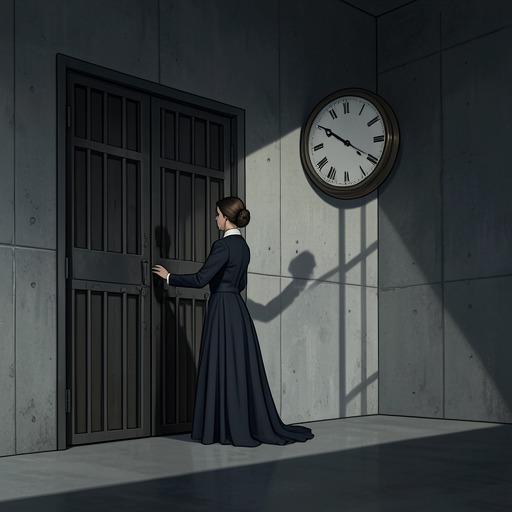
Mary Datchet
Night and DayMary Datchet is a suffrage organizer, an educated woman making her own life in London, and a friend whose private love for Ralph Denham is not returned. Her significance lies in the way these strands refuse to collapse into one another: she commits herself to political work, seeks intellectual pursuits beyond what she can comfortably disclose, and experiences romantic disappointment without ceasing to act. By the time Katharine Hilbery rushes out to find Ralph, Mary has reached a hard-won release from her own love and can accompany her friend without trying to possess the future she is pursuing.
Identity and Background
Mary’s London position is the culmination of a path she regards as almost miraculous. She remembers her clerical father in a country parsonage, her mother’s death, her determination to gain an education, and the transition from college into London. To her, the city appears like a vast electric light, drawing people toward a center that also occupies the imagination of those far away. Her sense of arrival does not make her complacent: it helps explain both her attachment to purposeful work and the seriousness with which she inhabits her place in the city.
That public seriousness has a private counterpart. In her room, away from the visible work of biography and the making of phrases, Mary secretly studies mathematics. She rises early or sits up late to do it, hiding her paper in a large Greek dictionary taken from her father’s room whenever footsteps sound on the stairs. She would sooner confess fantasies of a hurricane or prairie than this study. The secrecy marks an ambition she has not made part of her public identity, and exposes a tension between the work she is permitted to display and the intellectual vocation she guards for herself.
Work and Public Life
Mary’s working day has a defined rhythm: she says she is at it from ten to six. She is an unpaid amateur worker for a society promoting women’s suffrage, and the cause’s offerings have so far found little public demand. The office occupies the top floor of a large house in Russell Square, formerly a merchant’s home and now divided among societies. Typewriters and errand-boys fill the building from ten to six; other organizations publicize causes ranging from the protection of native races to the value of cereals. Mary runs up the last flight so her own typewriter can join the competition of the office. The bustle gives her work a concrete place in the city, even when its results are uncertain.
Her responsibilities go beyond routine correspondence. When the suffrage society is short of funds, Mary takes on her first large organizational project: a series of entertainments whose profits are meant to support it. She means to make the undertaking remarkable, using the cumbersome machinery of organization to draw interesting people out of the world’s muddle and assemble them for a week. The plan shows her appetite for effective action as well as the practical limits under which the society operates: it must raise money and attract support before it can advance its public purpose.
Her organizing does not end at the office door. Every other Wednesday, people seeking a place to discuss art, pleasure, or reform turn to her relatively large and conveniently situated rooms off the Strand. At about nine in the evening she resolves never to lend them again; nevertheless, she relents, on the condition that she controls the arrangements. A fortnightly meeting of a society for free discussion requires considerable moving and rearranging. The episode makes her domestic space part of a wider network of public activity, while the repeated resolve and reluctant accommodation reveal the personal labor that sustains it.
When the women’s suffrage vote is lost once more through a Parliamentary maneuver, the setback gives Mary’s work a sharper political context. Mrs. Seal responds with fury, covering the office with newspaper cuttings marked in blue and denouncing the duplicity of ministers and the insult to women. Mr. Clacton, by contrast, treats the reverse as a familiar stage in political campaigning and turns toward tactics: a revised card-index, new lemon-colored leaflets, and a large map of England. The failure of the vote does not end the society’s activity. Instead, it reveals the gap between the organizers’ labor and the immediate political result, and the range of responses through which they try to continue.
Mrs. Seal describes the cause as an obligation passing from one generation to the next, linking her own father’s pioneering work to the young women expected to carry it forward. She frames the women’s cause as a cause of humanity, though her speech is interrupted by the practical business of a boiling kettle and ends in a wistful insistence on the truth she believes the movement has seen. Against that expansive language, Mary’s own work is often made of letters, arrangements, and office hours. The contrast gives her commitment both a public ideal and a daily, material form.
Friendship, Love, and Political Difference
Mary and Ralph’s connection begins well before her feelings become explicit. Two years before one of their later conversations, she laughs at one of his remarks; she finds him astonishingly odd, and he laughs with her without quite knowing why. She is amused when he tells her how he divides his week among particular days and discovers, among his interests, an unexpected knowledge of bulldog breeding. Their friendship begins in an ease that is less deliberate than either a political alliance or a declaration of love.
The two can also meet through political questions. Walking across fields toward Lincoln with Ralph, Mary argues with him so intently that the rhythm of the discussion carries them along at more than four miles an hour, while they barely notice the hedgerows, plowland, or sky. Their minds are fixed instead on Parliament and the Government Offices in Whitehall. But shared concern does not remove the difference in what each is privately thinking. During a discussion of what women should do, Mary wants to turn toward something personal and discover Ralph’s feelings, then restrains herself. Ralph’s thoughts, meanwhile, turn toward Katharine and toward the romance and adventure he associates with her; unable to tell Mary, he pities her for not sharing what he imagines women lack. The scene sets Mary’s unspoken desire beside Ralph’s romantic idealization, and makes their emotional asymmetry visible before she names it.
At another meeting, Mary has a great deal to say but must leave for a committee. Before she goes, she pauses to ask whether Ralph is unhappy and whether something is wrong. The concern is direct, but the question also leaves open the possibility of confidence between them. Her political commitments require her to move on; her friendship makes her stop. This small exchange captures the doubleness of her role in his life: attentive and close, yet not the person to whom he can bring the feelings that occupy him.
Mary’s love becomes unmistakable to herself in a different kind of space. Instead of returning straight to the suffrage office, she visits the British Museum and sits beneath the Elgin marbles. The solitude and silence, as much as the statues, raise her into a solemn, heightened mood. Looking at the Ulysses, she nearly says aloud that she loves Ralph. The immense beauty around her does not supply the feeling; it gives her a setting in which the feeling comes close to speech. Her impulse remains private, and she returns to the problem of what her attachment means rather than making it a declaration to him.
Later, after leaving a tea party early, Mary intends to think through her position with Ralph and perhaps hear music at Queen’s Hall. The effort does not proceed neatly. Her thoughts change with the streets: a vision of humanity seems to belong to Bloomsbury and fades across the main road; an organ-grinder in Holborn diverts them; by Lincoln’s Inn Fields she feels cold, depressed, and horribly clear-sighted. The route turns private reflection into an uneven passage through the city. Her clarity does not arrive as a comforting conclusion, but as an insight she meets while alone.
Confession and the Meaning of Work
Mary finally tells Katharine what she has tried to hold within. She has believed herself reasonable and assumed that she could not be in love unless the other person felt the same. Now she recognizes that she had been foolish to let herself pretend. Her admission is not tentative: she says she is unquestionably in love with Ralph. As she speaks, she shakes her head forward, dislodging a lock of hair; her color brightens, and she looks proud and defiant. The physical force of the moment matters: her declaration is an act of self-recognition, not a request that Katharine correct or soften the truth.
That self-recognition hurts. In a rush of anguish that threatens her self-respect, Mary thinks that she could have given Ralph everything. The thought registers the full measure of what she had wanted to offer, even as the relationship she hoped for fails to materialize. Her sorrow is not abstract disappointment; it is attached to the imagined future she has to relinquish.
Mary also argues for the value of work from experience rather than principle alone. She tells Katharine that Katharine has never had to understand work and has only recently discovered it herself, then calls work the thing that saves one. The claim is shaped by contrast: Katharine’s circumstances have protected her from the kind of necessity Mary knows, while Mary’s own labor supplies a structure she can rely on. Mary does not present work as a reward that erases unhappiness; she presents it as a support through which a person can continue.
Her approval of Katharine is equally plain. Mary tells her that everything has turned out splendidly for herself and will, she believes, do so for Katharine, because Katharine is worth it. Such encouragement does not undo the strain of loving the same man, nor does it pretend that their positions are identical. It shows Mary directing her care toward Katharine even when her own longing has made that friendship painful.
Release and Narrative Role
The Parliamentary defeat leaves the suffrage office in mourning, but it also finds Mary returned to the work around which she has organized her days. The society’s response—Mrs. Seal’s outrage and Mr. Clacton’s renewed tactical planning—makes clear that disappointment is not a single private emotion in Mary’s story: it is also part of a public campaign in which reverses demand further labor. Mary’s personal disappointment unfolds alongside, not in place of, that political persistence.
When Katharine urgently asks for Ralph’s address, Mary understands that something in her friend’s feeling exceeds her own ability to follow. Katharine’s gaze seems to pass beyond the room and beyond words; Mary is baffled and tries to call back the height of her own love for Ralph. The comparison does not revive her attachment in its former form. As the two walk rapidly along the Strand, Mary accompanies Katharine without knowing where she is going. She is preoccupied with the unexpected discovery made that night: she is free again, though at the cost of a gift she had hoped to give. She even imagines celebrating that freedom at the Coliseum, but the impulse belongs to possibility rather than a reported action.
Mary’s ending is therefore neither romantic fulfillment nor retreat from public life. Her love for Ralph has mattered profoundly, but it does not secure him, and it does not cancel the working identity she has built. The movement from a nearly spoken confession beneath the Elgin marbles, through the painful admission to Katharine, to the walk along the Strand traces a change in what she can bear: first she conceals the feeling, then names it, and finally recognizes its release. She remains capable of friendship and public purpose after the loss. In her, political work is not a substitute for private feeling so much as a durable form of life alongside it.